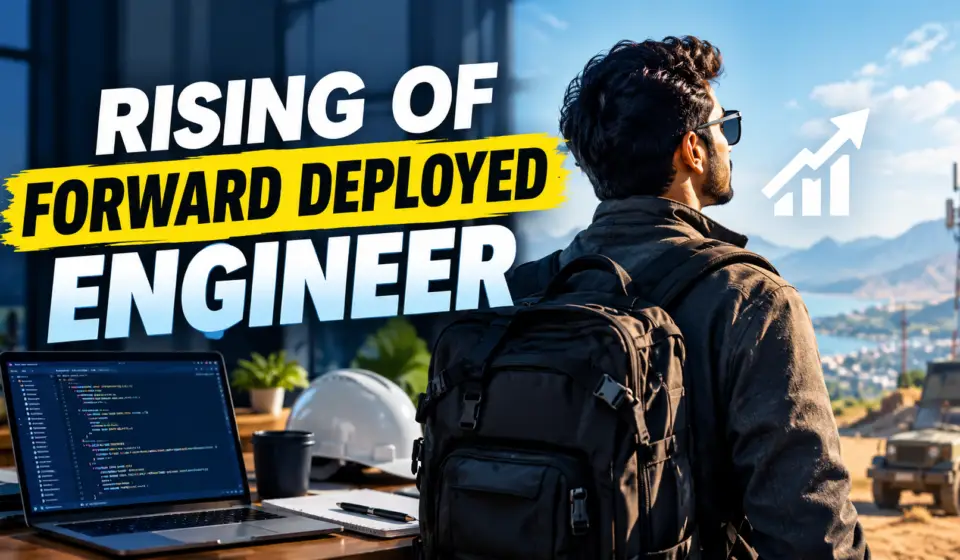

The Rise of the Forward Deployed Engineer in 2026: The New Career Shaping the AI Industry
Artificial intelligence is entering a new phase in 2026. The focus is no longer only on building larger and more powerful AI models. Companies are now trying to answer a much more practical question: How can we use AI to solve real business problems?
This change is creating demand for a new type of technology professional known as the Forward Deployed Engineer (FDE).
Forward Deployed Engineers combine software engineering, artificial intelligence, product development, system integration and customer-facing problem solving. They work directly with organizations to take emerging technologies and turn them into practical solutions that can operate in the real world.
In 2026, the role is becoming increasingly important as businesses move from experimenting with AI to deploying AI systems across their everyday operations.
What Is a Forward Deployed Engineer?
A Forward Deployed Engineer is a technical professional who works closely with customers or business teams to build and deploy customized technology solutions.
The term “forward deployed” comes from the idea of putting engineers close to the problem instead of keeping them completely separated from the customer. Rather than waiting for requirements to travel from a customer to a product team and then to an engineering team, the FDE can work directly with the customer, understand the problem and build a solution.
This makes the role particularly valuable for artificial intelligence because every organization has different data, software, workflows, security policies and business requirements.
An AI model may be powerful, but that does not automatically mean it will work inside a company’s existing environment. The FDE is responsible for closing that gap.
In simple terms
A Forward Deployed Engineer is the person who asks:
“We have this powerful AI technology. How can we make it actually work for this company?”
Why Is the Forward Deployed Engineer Becoming So Important in 2026?
The AI industry has changed significantly over the past few years. Earlier, much of the competition was focused on developing increasingly capable foundation models.
In 2026, access to advanced AI models is becoming easier for businesses. Companies can access AI capabilities through APIs, cloud platforms and specialized AI services.
The difficult part is no longer simply getting access to AI. The difficult part is integrating AI into real business processes.
Consider a company that wants to introduce an AI-powered customer service system. Simply connecting an AI model is not enough.
The company may also need:
- Access to internal customer information
- Integration with its CRM
- Connections to internal APIs
- Database access
- Authentication and authorization
- Security controls
- Monitoring
- AI evaluation systems
- Human approval mechanisms
- Reliable production infrastructure
This is where the Forward Deployed Engineer becomes critical.
Instead of simply demonstrating what AI can do, the FDE focuses on making AI useful, reliable and operational.
From AI Experiments to Real-World Deployment
One of the biggest changes happening in 2026 is the transition from AI experimentation to AI deployment.
Many organizations have already experimented with chatbots, copilots, generative AI tools and AI assistants.
But building a demonstration is relatively easy compared with deploying an AI system that thousands of employees or customers depend on.
Production AI must deal with unpredictable inputs, security requirements, changing data, system failures, costs and performance requirements.
FDEs help organizations move through this difficult stage.
The typical journey looks like this:
- Identify a business problem.
- Determine whether AI can solve the problem.
- Design a technical solution.
- Build a prototype.
- Connect the solution to company data and systems.
- Test the system.
- Evaluate AI performance.
- Add security and reliability controls.
- Deploy the system.
- Monitor and improve it continuously.
The FDE can participate in almost every stage of this process.
What Does a Forward Deployed Engineer Actually Do?
The responsibilities of an FDE can vary significantly between companies. However, most roles combine several different areas of work.
1. Understand Customer Problems
The first responsibility is understanding what the customer actually needs.
Customers do not always describe problems in technical terms. They may say that a process is too slow, employees are spending too much time on manual work or customers are waiting too long for support.
The FDE must translate those business problems into technical requirements.
2. Design Technical Solutions
Once the problem is understood, the engineer determines how technology can solve it.
This might involve building a new application, connecting APIs, creating an AI agent, implementing a RAG system or integrating an AI model with existing enterprise software.
3. Build Prototypes
FDEs frequently build prototypes quickly to demonstrate whether an idea is technically possible.
Speed is important because businesses need to understand the potential value of an AI solution before investing significant resources in it.
4. Integrate Existing Systems
Enterprise environments rarely start from scratch.
Companies may already have databases, CRM platforms, ERP systems, internal applications and legacy software.
The FDE must make the new AI solution work with these existing systems.
5. Deploy to Production
Creating a prototype is only the beginning.
The engineer must eventually deploy the system so that real users can depend on it.
6. Monitor and Improve the System
AI systems require continuous improvement.
The FDE may monitor performance, investigate failures, improve prompts, change retrieval systems, modify workflows and optimize infrastructure.
Forward Deployed Engineer vs Traditional Software Engineer
Although both roles involve software development, their working environments can be very different.
| Traditional Software Engineer | Forward Deployed Engineer |
|---|---|
| Usually works primarily within an engineering organization. | Often works directly with customers or business teams. |
| Usually works from defined product requirements. | Often helps discover and define the problem. |
| Focuses heavily on product development. | Focuses heavily on solving specific customer problems. |
| May work on long-term product features. | Often works on rapid prototypes and deployments. |
| Customer interaction may be limited. | Customer communication is often an important part of the job. |
How AI Agents Are Increasing Demand for FDEs
AI agents are one of the most important technologies driving the FDE trend.
A traditional AI chatbot generally responds to a user’s question. An AI agent can potentially perform a sequence of actions to accomplish a particular objective.
For example, an enterprise AI agent might receive a customer request, search internal documentation, retrieve information from a database, call an external API and prepare a response.
This creates enormous opportunities for automation.
But it also creates enormous engineering challenges.
AI agents need to operate within permissions, access the right information, handle failures and provide reliable results.
FDEs are well positioned to solve these problems because their work sits between AI technology and enterprise software.
Key Skills Required to Become a Forward Deployed Engineer
Becoming an FDE requires more than knowing how to write code. The strongest candidates usually have a combination of technical, AI and communication skills.
1. Programming
Programming remains the foundation of the role.
Useful languages include:
- Python
- JavaScript
- TypeScript
- Java
- Go
2. Backend Development
FDEs should understand how backend systems operate, including databases, APIs, authentication and distributed systems.
3. Artificial Intelligence
Modern FDEs increasingly need practical knowledge of AI technologies.
- Large Language Models
- Generative AI
- RAG systems
- AI agents
- Vector databases
- Embeddings
- Prompt engineering
- Model evaluation
- AI safety and guardrails
4. Cloud Computing
Enterprise AI applications frequently run on cloud infrastructure. Knowledge of platforms such as AWS, Microsoft Azure and Google Cloud can therefore be highly valuable.
5. APIs and System Integration
An FDE should be comfortable connecting different software systems.
This includes understanding REST APIs, authentication, webhooks, databases and third-party services.
6. Communication Skills
Technical ability alone is not enough.
FDEs frequently communicate with customers, executives, product managers, engineers and business teams.
An engineer who can explain a complex technical problem in simple language can become extremely valuable.
7. Business Understanding
FDEs need to understand why a solution matters to the business.
Building an impressive AI system is not enough if it does not save time, reduce costs, improve revenue, increase productivity or improve customer experience.
Why Communication Is One of the Most Important FDE Skills
One of the biggest differences between an FDE and a traditional developer is the amount of communication involved.
An FDE might spend the morning discussing a customer’s workflow and the afternoon writing code.
They must be comfortable switching between technical and non-technical conversations.
For example, a business executive might say:
“Our employees spend too much time searching through thousands of documents.”
The FDE needs to translate that statement into a technical solution such as document ingestion, retrieval, embeddings, access control, an AI interface and evaluation.
This ability to translate between business problems and engineering solutions is one of the defining characteristics of the FDE role.
Why India Could Become a Major Hub for Forward Deployed Engineers
India has several advantages that could support the growth of Forward Deployed Engineering.
The country already has a large software engineering workforce and a well-established IT-services industry.
Cities including Bengaluru, Hyderabad, Pune, Chennai, Mumbai and Delhi-NCR have large technology ecosystems.
India is also home to many global technology and enterprise engineering centers.
As these organizations move from AI experimentation to production deployments, demand for engineers who understand both software and artificial intelligence is likely to increase.
How Much Can a Forward Deployed Engineer Earn?
Compensation varies widely depending on experience, location, company, technical skills and the complexity of the role.
FDE positions at major technology companies and AI startups can be particularly competitive because the role combines several high-value skills.
Engineers with strong software development experience, cloud knowledge, AI expertise and customer-facing abilities may have an advantage in the job market.
Candidates should therefore avoid choosing an FDE career purely because of salary. The long-term value of the role comes from developing a rare combination of technical and business skills.
How to Become a Forward Deployed Engineer in 2026
There is no single educational path required to become an FDE. A strong technical foundation and practical project experience are often more important than simply collecting certificates.
Step 1: Learn Programming
Start with Python or another widely used programming language. Learn data structures, APIs, databases and backend development.
Step 2: Learn AI Fundamentals
Understand how modern AI systems work and learn how to use LLM APIs. Study RAG, embeddings, AI agents and model evaluation.
Step 3: Learn Cloud and Deployment
Learn how applications are deployed using cloud infrastructure. Understand containers, databases, authentication, logging and monitoring.
Step 4: Build Real Projects
Build projects that solve actual problems instead of creating simple chatbot demonstrations.
For example:
- An AI document analysis system
- An internal company knowledge assistant
- An AI customer-support agent
- An AI research assistant
- An automated business workflow
- An AI system connected to multiple APIs
Step 5: Deploy Your Projects
Do not stop at writing code. Deploy your application and make it usable.
Step 6: Learn to Explain Your Work
Document what problem your project solves, why you selected your approach, what challenges you faced and how you measured success.
This demonstrates the exact type of thinking companies look for in FDE candidates.
What Should an FDE Portfolio Look Like?
A strong FDE portfolio should demonstrate more than coding ability. It should demonstrate problem-solving ability.
Each project should ideally explain:
- What problem did you identify?
- Who experiences this problem?
- Why is the problem important?
- Why is AI useful for solving it?
- What technology did you use?
- How did you integrate different systems?
- How did you handle security?
- How did you evaluate the AI?
- What were the limitations?
- What results did you achieve?
This style of portfolio can make an engineer stand out because it demonstrates the ability to think beyond individual lines of code.
Advantages of Becoming a Forward Deployed Engineer
High Exposure to Emerging Technology
FDEs often work with new AI tools and technologies before they become mainstream.
Direct Business Impact
Instead of building features that may take years to reach customers, FDEs can see the direct impact of their work.
Strong Career Flexibility
The combination of engineering, AI and business skills can open doors to careers in product engineering, solutions architecture, AI engineering, technical consulting and product management.
Continuous Learning
Because every customer problem can be different, FDEs are constantly exposed to new industries, technologies and challenges.
Challenges of the FDE Career
Despite its advantages, Forward Deployed Engineering is not an easy career.
Constantly Changing Requirements
Customers may change their requirements as they learn more about the technology.
High Pressure
FDEs may be expected to deliver working solutions quickly.
Broad Technical Knowledge
Engineers may need to understand several technologies instead of specializing in only one area.
Customer Expectations
Because FDEs work closely with customers, communication problems can become engineering problems.
Engineers who prefer working independently on a narrowly defined technical problem may find the role challenging.
Will AI Replace Software Engineers or Create More FDE Jobs?
AI is already changing software development. AI coding assistants can generate code, explain errors, write tests and accelerate development.
But this does not eliminate the need for engineers who understand the underlying business problem.
In fact, AI may increase the importance of engineers who can determine what should be built and how it should be integrated into the real world.
When AI makes coding faster, the bottleneck can move toward problem definition, system integration, evaluation and deployment.
Those are exactly the areas where FDEs operate.
The Future of Forward Deployed Engineering
The rise of the FDE represents a broader transformation in the technology industry.
Software companies are no longer competing only on the features of their products. They are increasingly competing on how quickly and effectively those products can solve customer problems.
AI makes this even more important.
A powerful model by itself does not create business value. Business value appears when that model is connected to data, workflows, software and people.
Forward Deployed Engineers are becoming the people responsible for making that connection.
Conclusion: Why FDE Could Become One of the Most Important AI Careers
The rise of the Forward Deployed Engineer in 2026 is a sign that the AI industry is entering a new stage.
The early AI race focused heavily on building increasingly powerful models. The next stage is focused on turning those models into useful products, services and business systems.
This requires engineers who understand more than programming. They need to understand AI, cloud infrastructure, APIs, data, security, customers and business objectives.
That combination makes the Forward Deployed Engineer one of the most interesting emerging technology roles of 2026.
For developers planning their careers, the opportunity is clear:
Don’t just learn how to build AI. Learn how to deploy it, integrate it, evaluate it and use it to solve real-world problems.
As businesses move from AI experiments to production systems, the engineers who can bridge the gap between technology and real-world implementation could become some of the most valuable professionals in the technology industry.
Frequently Asked Questions About Forward Deployed Engineers
What is a Forward Deployed Engineer?
A Forward Deployed Engineer is a software or AI engineer who works closely with customers to understand their problems and build customized technical solutions.
Is Forward Deployed Engineering a new job?
The concept has existed for years, but the role is becoming much more visible in 2026 because of the rapid adoption of generative AI and AI agents.
Do FDEs need to know artificial intelligence?
Increasingly, yes. Modern FDE positions often involve generative AI, AI agents, RAG systems, APIs and enterprise AI deployments.
Do I need a computer science degree?
A computer science degree can be helpful, but practical engineering skills, strong projects and the ability to solve real problems can also be highly valuable.
Is FDE a good career in 2026?
For people who enjoy both technology and customer-facing problem solving, it can be an attractive career path. The combination of software engineering, AI and business knowledge is increasingly valuable.
What is the most important skill for an FDE?
There is no single skill. The strongest FDEs combine software engineering, AI knowledge, system integration, communication and business problem solving.


