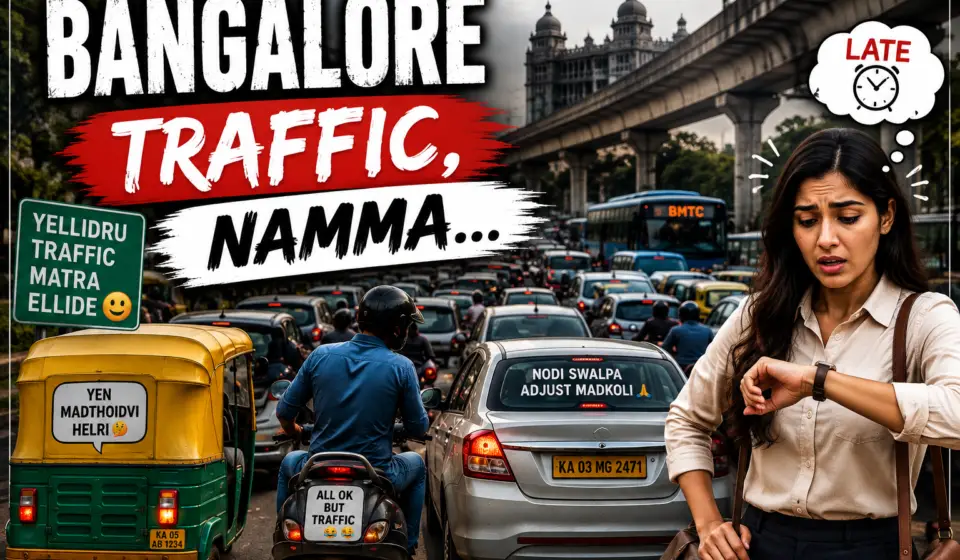

Ask anyone who commutes in Bangalore and you’ll get the same answer: the traffic has never been this bad. That’s not just a feeling — the data backs it up. Here’s a look at how bad things really are, why it’s happening, and what projects are underway to fix it.
Bangalore Is Now the World’s Second Most Congested City
According to the TomTom Traffic Index, Bangalore has climbed from sixth place globally in 2023 to third in 2024, and is now ranked the world’s second most congested city. Average peak-hour speeds in the city have dropped to just 13-14 km/h, and commuters are losing roughly 168 hours — about seven full working days — to traffic every single year.
On the worst recorded day, drivers needed a full 15 minutes to cover just 2.5 km, and evening queues at Veerannapalya Junction stretched to 15.8 km. A widely shared story that captured the mood of the city involved a commuter who took nearly two hours to travel six kilometres from Indiranagar to Manyata Tech Park — at 3:30 in the morning, when the roads should have been empty.
It wasn’t always this dramatic. In 2024, Bangalore ranked as the world’s third-slowest city, behind only Barranquilla in Colombia and Kolkata, with an average travel time of just over 34 minutes per 10 km and a congestion level of 38%. The trend line is clearly moving in the wrong direction.
Why Bangalore’s Roads Are So Overwhelmed
Too Many Vehicles, Not Enough Road
The core problem is simple math. Bangalore added 7.22 lakh new vehicles in 2024-25 alone — 4.68 lakh two-wheelers and 1.45 lakh cars — pushing total vehicle registrations in the city to 1.23 crore, up 6.5% from the previous year. That works out to more than 60,000 new vehicles hitting the road every month, or nearly 2,000 a day.
Meanwhile, the road network simply hasn’t grown to match. With only around 15,000 km of roads in the city, vehicle density has jumped from 761 vehicles per km in 2023-24 to 823 vehicles per km in 2024-25. More vehicles are fighting for the same stretch of tarmac every year.

The Worst Junctions and Stretches
Bangalore Traffic Police data points to specific pressure points: Gokaldas Images Junction in North Bangalore sees morning queues stretching to 9.9 km, while Veerannapalya Junction near BEL tops the evening congestion list at 15.8 km. The Outer Ring Road corridor between Hebbal and Silk Board, along with Whitefield, Electronic City, and stretches under metro construction, remain the most chronically jammed parts of the city.
Growth Without a Public Transport Backbone
The underlying issue that keeps coming up in official commentary is Bangalore’s dependence on private vehicles. Karnataka’s Transport Minister Ramalinga Reddy has acknowledged that congestion is worsening and said the state needs to evaluate measures such as widening roads, introducing parking charges, or even an odd-even vehicle rule. Even residential inner streets aren’t spared anymore — a growing number of apartment complexes across the city have pushed traffic off the main roads and into neighbourhood lanes that were never built to handle it.
What’s Being Done to Fix Bangalore’s Traffic
Namma Metro Expansion
The most significant long-term fix underway is the expansion of Namma Metro. The network currently runs across 96 km and serves about 10 lakh commuters daily, with another 41 km of new lines planned for completion in 2026-27. The long-delayed 19-km Yellow Line connecting RV Road to Bommasandra finally opened in August 2025, the same day the foundation stone was laid for Namma Metro Phase 3, a project worth over Rs 15,610 crore. The Pink Line is expected to open in two phases by September 2026.
The airport route is getting particular attention. The Blue Line extension connecting Kasturinagar to Kempegowda International Airport, part of Phase 2B, is expected to become operational by June 2026 and should meaningfully cut traffic on the airport road.
Suburban Rail
Alongside the metro, the Bengaluru Suburban Rail Project is finally moving forward after decades of delay. The Majestic-to-airport-terminal corridor is targeted for completion by December 2027, while a separate corridor between Baiyyappanahalli and Chikkabanavara via Hebbal and Yeshwantpur is currently under construction. A new multi-modal transport hub combining BMTC buses, metro, and suburban rail is also planned near Hebbal Flyover to make switching between modes easier.
Roads, Footpaths and Junction Upgrades
The state’s latest budget also commits to a wider infrastructure push. This includes white-topping 158 km of roads at a cost of Rs 1,700 crore, with plans to white-top over 450 km more over the next three years for Rs 3,000 crore, alongside the beautification of 175 junctions, an upgrade of 500 km of footpaths, and the construction of 100 skywalks across the city.
Bangalore’s Traffic Congestion Ranking Over the Years
| Year | Global TomTom Ranking |
|---|---|
| 2022 | 2nd most congested |
| 2023 | 6th most congested |
| 2024 | 3rd slowest city |
| 2025 | 2nd most congested |
The takeaway: while the metro and infrastructure projects are real and progressing, vehicle growth is currently outpacing them — which is why congestion has spiked back up rather than easing.
What Commuters Can Do Right Now
While the big fixes play out over the next few years, a few practical habits can help you avoid the worst of it:
- Check live traffic before you leave using Google Maps or the Bangalore Traffic Police app, especially around Hebbal, Silk Board, and ORR stretches.
- Shift your commute window where possible — even a 30-45 minute shift outside peak hours can save significant time on arterial roads.
- Use the metro for cross-city trips wherever a line already connects your route, particularly on the Purple and Green lines.
- Avoid Outer Ring Road during 8-10 AM and 6-8 PM if you have any alternate route, since this remains the most consistently jammed corridor in the city.
- Track long-weekend surges — traffic police data shows return-journey congestion on roads like Tumakuru Road and Mysuru Road spikes sharply the day after long weekends.
Frequently Asked Questions
Is Bangalore the most congested city in the world? Not quite — it’s currently ranked the world’s second most congested city, behind other cities in the TomTom Traffic Index, but it remains the most congested city in India.
Which are the worst traffic junctions in Bangalore? Veerannapalya Junction near BEL and Gokaldas Images Junction in North Bangalore consistently rank among the worst, along with the Hebbal-to-Silk Board stretch of the Outer Ring Road.
Will the metro actually reduce Bangalore’s traffic? It should help significantly on routes it covers — particularly the upcoming airport line — but with over 60,000 new vehicles added to the city every month, metro and rail expansion alone won’t be enough without complementary measures like better bus services and parking policy.
When will the airport metro line open? The Blue Line extension to Kempegowda International Airport is expected to be operational by June 2026.


