
Data Analytics: The Complete Guide to Turning Information Into Insight
In today’s hyper-connected world, businesses generate more data every single day than entire industries produced in a decade just twenty years ago. From customer clicks to sensor readings, from social media chatter to financial transactions, data is everywhere. But raw data alone is worthless — it’s what you do with it that counts. This is where data analytics comes in, transforming chaotic streams of numbers and text into clear, actionable insight that drives smarter decisions.
What Is Data Analytics?
Data analytics is the science of examining raw data to uncover patterns, draw conclusions, and support decision-making. It combines statistics, computer science, and domain expertise to answer questions like “What happened?”, “Why did it happen?”, “What will happen next?”, and “What should we do about it?”
Organizations across every sector — healthcare, retail, finance, manufacturing, sports, government — now rely on data analytics to optimize operations, understand customers, reduce costs, and stay competitive.
The Four Types of Data Analytics
1. Descriptive Analytics — “What happened?”
This is the most basic form of analytics. It summarizes historical data to understand trends and patterns. Think of monthly sales reports, website traffic dashboards, or quarterly revenue summaries. Descriptive analytics answers questions about past performance using tools like averages, totals, and percentages.
2. Diagnostic Analytics — “Why did it happen?”
Diagnostic analytics digs deeper into data to identify the root causes of trends or anomalies. If sales suddenly dropped in a particular region, diagnostic analytics helps pinpoint whether it was due to pricing changes, competitor activity, supply chain issues, or shifting customer preferences.
3. Predictive Analytics — “What will happen next?”
Using statistical models and machine learning, predictive analytics forecasts future outcomes based on historical data. Retailers use it to predict demand, banks use it to assess credit risk, and healthcare providers use it to anticipate patient readmissions.
4. Prescriptive Analytics — “What should we do?”
The most advanced form, prescriptive analytics not only predicts outcomes but recommends specific actions to achieve desired results. Airlines use it for dynamic pricing, logistics companies use it for route optimization, and marketers use it to determine the best channel and timing for campaigns.
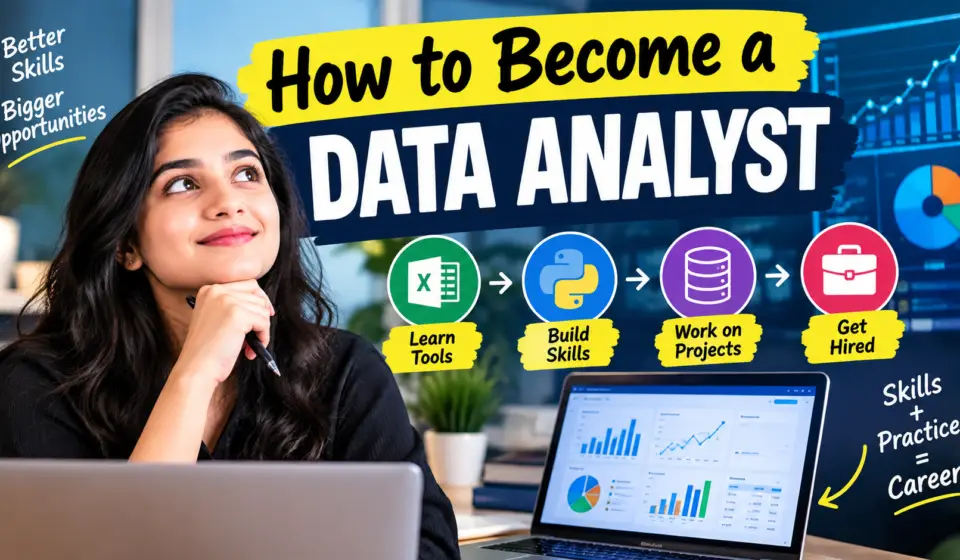
The Data Analytics Process
A typical data analytics workflow follows these key stages:
- Data Collection — Gathering raw data from various sources such as databases, sensors, surveys, social media, or transaction logs.
- Data Cleaning — Removing errors, duplicates, and inconsistencies to ensure data quality (often the most time-consuming step).
- Data Exploration — Using visualization and summary statistics to understand the data’s structure and spot initial patterns.
- Data Modeling — Applying statistical or machine learning models to extract deeper insights or make predictions.
- Interpretation & Visualization — Translating findings into charts, dashboards, and reports that stakeholders can easily understand.
- Decision-Making & Action — Using insights to inform business strategy, product development, or operational changes.
Popular Tools and Technologies
The data analytics ecosystem is rich with tools suited to different needs:
- Programming Languages: Python and R remain the top choices for statistical analysis and machine learning.
- Business Intelligence Tools: Tableau, Power BI, and Looker help create interactive dashboards for non-technical users.
- Big Data Frameworks: Apache Hadoop and Apache Spark handle massive datasets that traditional tools can’t process.
- Databases: SQL remains essential, while NoSQL databases like MongoDB handle unstructured data.
- Cloud Platforms: AWS, Google Cloud, and Microsoft Azure offer scalable analytics infrastructure without heavy upfront investment.
Why Data Analytics Matters Today
Better Decision-Making: Companies that rely on data rather than intuition make more consistent, defensible decisions.
Improved Customer Understanding: Analytics reveals customer behavior patterns, enabling personalized marketing and improved products.
Operational Efficiency: Businesses can identify bottlenecks, reduce waste, and optimize resource allocation.
Risk Management: Predictive models help organizations anticipate and mitigate risks before they escalate.
Competitive Advantage: In crowded markets, the ability to extract insights faster than competitors can be a decisive edge.
Real-World Applications
- Retail: Amazon uses purchase history and browsing behavior to power its recommendation engine.
- Healthcare: Hospitals use predictive analytics to identify patients at risk of complications before symptoms appear.
- Finance: Banks use analytics to detect fraudulent transactions in real time.
- Sports: Teams use performance data to optimize training and game strategy — a practice popularized by the “Moneyball” approach in baseball.
- Urban Planning: Cities use traffic and sensor data to reduce congestion and improve public transportation.
Challenges in Data Analytics
Despite its benefits, data analytics comes with real challenges:
- Data Quality: Inaccurate or incomplete data can lead to flawed insights.
- Privacy Concerns: Handling personal data responsibly requires strict compliance with regulations like GDPR.
- Skill Gaps: There’s a global shortage of skilled data analysts and data scientists.
- Integration Issues: Combining data from multiple, often incompatible, sources is technically demanding.
- Bias in Models: Poorly designed algorithms can unintentionally reinforce existing biases.
The Future of Data Analytics
Emerging trends are reshaping the field:
- Artificial Intelligence & Machine Learning are automating deeper, faster analysis than ever before.
- Real-Time Analytics is enabling instant decision-making, crucial for fraud detection and IoT applications.
- Augmented Analytics uses AI to automate data preparation and insight generation, making analytics accessible to non-experts.
- Data Democratization is putting analytical tools directly into the hands of business users, not just technical teams.
Conclusion
Data analytics has evolved from a niche technical function into a core pillar of modern business strategy. As data volumes continue to explode and technology becomes more sophisticated, organizations that master the art and science of analytics will be best positioned to innovate, compete, and thrive. Whether you’re a small business owner or a global enterprise, understanding data analytics is no longer optional — it’s essential.
Microsoft puts business AI into single app to compete with AnthropicCoverage of Apple’s $5.7B patent verdict, China’s push into the US data center boom, and Chinese AI models surging in global popularity.
CNBC TechnologyMost Americans now oppose data centers in some wayPublic sentiment shifting on AI infrastructure, plus cloud/AI billing shocks from runaway AI agent spending.
TechRadarDoubts rise over frontier AI as cheaper Chinese models close the gapDaily AI news roundup covering OpenAI, Anthropic, and enterprise AI model competition.
Creati.ai2026 in Artificial Intelligence — TimelineA running log of major AI events through 2026, including AI security incidents and research breakthroughs.
Wikipedia


