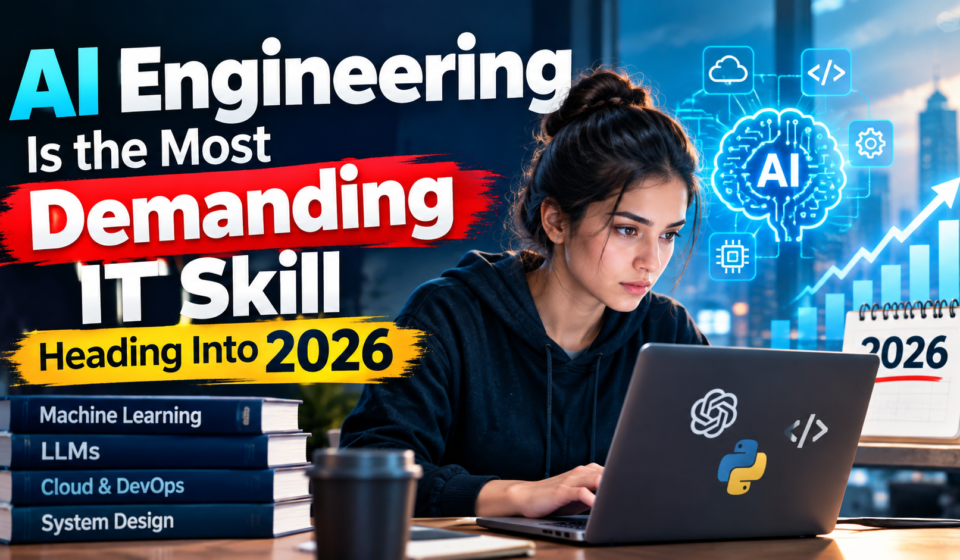

AI Engineering Is the Most Demanding IT Skill Heading Into 2026
If one skill separates in-demand IT professionals from everyone else this year, it’s the ability to build, deploy, and manage AI systems — not just talk about AI, but engineer it into real products.
By the Technology Desk · 6 min read
Why AI engineering tops the list
The numbers tell the story. AI and machine learning engineering leads the list of most in-demand IT skills for 2026, alongside cybersecurity, cloud computing, DevOps, full-stack development, and data engineering. But within that cluster, AI engineering stands out for its growth rate.
+143%
Year-over-year growth in “AI Engineer” job postings in the US — currently the fastest-growing job title in the country.
What’s driving this isn’t just hype — it’s structural. AI has reshaped every discipline in IT: cybersecurity teams now need AI-powered threat detection, cloud architects must integrate AI services, DevOps pipelines increasingly rely on AI-assisted code review, and full-stack developers are expected to work fluently with AI coding assistants. AI engineering isn’t a siloed specialty anymore — it’s becoming a layer underneath almost every other IT role.
Hiring data backs this up. Between 2024 and 2025, the share of job postings requiring AI skills grew from just over 5% to more than 9%, meaning even professionals outside dedicated AI roles are now expected to have some baseline AI competency — whether that’s prompt engineering, natural language processing, or using AI tools to write and review code.
What “AI engineering” actually demands
This isn’t a skill picked up over a weekend. Genuine AI engineering competency typically requires:
- Model deployment and MLOps — taking a trained model and reliably running it in production, monitoring drift, and retraining as needed.
- Prompt and context engineering — designing how large language models are fed information to get consistent, reliable outputs.
- Integration skills — connecting AI systems into existing software stacks, APIs, and business workflows, not just running notebooks in isolation.
- Data engineering fundamentals — building the pipelines that feed AI systems, since those systems are only as good as the data behind them.
- Security awareness — understanding how AI systems can be exploited, poisoned, or misused, as cybersecurity remains the most critical hiring priority in IT overall.
AI and security are converging: teams building AI products increasingly need to secure them, and security teams increasingly need AI literacy to defend against AI-enabled threats.
The skills that support it
AI engineering doesn’t exist in a vacuum — it sits on top of a stack of other in-demand skills that recruiters keep circling back to:
- Cloud computing — AWS, Microsoft Azure, and Google Cloud Platform dominate enterprise environments, with employers prioritizing hands-on experience in containerization tools like Docker and Kubernetes, and infrastructure-as-code tools like Terraform.
- Programming fundamentals — Python remains central across data analysis, web development, scientific computing, and AI/ML model building.
- Core technical literacy — cloud computing, cybersecurity, AI literacy, SQL, Python, Linux, networking, DevOps, and automation round out the skill set employers are screening for.
It’s not just technical anymore
Here’s the twist that catches a lot of engineers off guard: technical depth alone isn’t enough. The most competitive IT professionals in 2026 pair cutting-edge technical skills with human-centered capabilities — communication, collaboration, adaptability, and critical thinking — increasingly treated as core differentiators rather than nice-to-haves.
This shift is reshaping how companies hire, too. Employers are moving toward skills-based hiring, placing less weight on job titles or years of experience and more on demonstrable, real-world competencies. For AI engineers specifically, that means a portfolio of shipped projects increasingly outweighs a resume full of certifications.
The bottom line
The demand data is consistent across every major source tracking the 2026 hiring market: AI and machine learning skills sit at the top, with cybersecurity and cloud computing close behind as the load-bearing pillars underneath them. But the professionals who will command the biggest salary premiums aren’t the ones who can merely describe how a large language model works — they’re the ones who can deploy one, secure it, integrate it into a cloud-native pipeline, and explain the business impact to a non-technical stakeholder.
In 2026, AI engineering isn’t a niche specialty. It’s quickly becoming the baseline expectation for anyone who wants to stay competitive in IT.
Further reading
- The 10 hottest IT skills for 2026CIO
- 10 Most In-Demand IT Skills to Master in 2026Edstellar
- Most In-Demand IT Skills Employers Want in 2026NRI Staffing
Sources: industry hiring and workforce reports on IT skills demand, 2025–2026.


